
Latest Blogs
Using Company Assets for Private Purposes: A Tax Guide
It is important for you to report assets and money taken from a trust or company as income in your tax return. Who must know? This information helps you understand how to record money taken from your business, or business assets used for personal purposes, for tax...
Tax Invoice Guide: When to Issue One and What to Include
When to provide a tax invoice If your client asks for a tax invoice, you are required to provide one within 28 days, unless it is for a sale of $82.50 or less. The information a tax invoice needs to include depends on: the sale amount The type of sale (for instance, a...

How Can You Tell If Your Business Is Financially Healthy?
As a business owner, you are responsible for keeping an eye on your business’s financial health. Instead of wasting time analysing everything at the time of tax return lodgment, keep checking your company's financial health. Understanding a financial health check A...
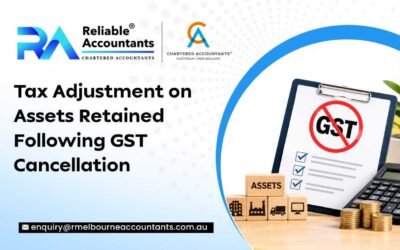
Tax Adjustment on Assets Retained Following GST Cancellation
In this blog, we’ll discuss how you can repay GST credits on business assets after GST registration is cancelled. Adjusting business assets Even after cancelling your GST registration, if you still have business assets for which you earlier claimed GST credit, you...

What Should You Know Before Setting Up a Company?
Before you start a business, you are required to consider tax, super, and registration obligations. Things you need to consider before starting a business To run a business successfully, you must be prepared for things that might be coming ahead. Here, we have...
Treasury Laws Amendment Bill 2026: Key Tax Adviser Changes
Treasury Laws Amendment (Strengthening Accountability for Tax Adviser Misconduct and Other Measures) Bill 2026 The Treasury Laws Amendment (Strengthening Accountability for Tax Adviser Misconduct and Other Measures) Act 2026 received Royal Assent on 15 September 2026...
ATO Guidance on Software Royalties, PAYG Withholding & Foreign Resident CGT
Software Royalties The ATO has finalised TR 2026/2, which clarifies when payments under software intermediation arrangements are treated as a royalty under section 6(1) of the ITAA 1936 and are liable for withholding tax. The ruling emphasises cross-border payments...
From the Regulators: Key Tax, Superannuation, CGT, PAYG, FBT and Compliance Updates
Super for sportspeople, performers, filmmakers and related activities The ATO has updated its website guidance on SG obligations for payments made to filmmakers, performers, sportpeople, and others involved in similar activities. When you pay an employee, the SG...
Government Tax Update: From Trust Taxation to EVs, R&D and Superannuation
30% Minimum Tax for Discretionary Trusts Treasury has released draft legislation for a 30% minimum tax on discretionary trusts to be introduced from 1 July 2028. The draft covers: An explanation of how the 30% minimum tax will work. Trusts and income that are...

What Happens If an Employer Misses a Payday Super Payment?
What if you miss a super contribution? You are required to fix this issue by making outstanding amounts to your employee’s super fund. Even if you are unable to pay the full amount, you can pay a partial amount to the fund to reduce the SG charge that you will become...
How to Prepare for Tax Time: A Business Owner’s Checklist
When tax season is around the corner, you need to look after numerous things, especially if you are running a company, irrespective of whether it’s a small or large organisation. To avoid juggling between accounts, you should prepare everything before the last minute....

Rental Property Investment in Australia
Before you buy your rental property Here are a few things to consider when buying a rental property so you can be sure that you are on the right track. Obtain the right information Before you start, if you are looking to buy a rental property or have already bought...
A Guide to Concessional and Non-Concessional Contributions
In this guide, you will come to know which contributions are after-tax or before-tax and how tax and super rules apply to them. Tax and restrictions on contributions Your super is taxed at a lower rate than most investments and income. However, if your contributions...
What Records Do You Need to Claim Business Tax Deductions?
To claim deductions in your tax return for expenses incurred for business purposes, you need to have accurate records to substantiate your claims. Your records need to show how you worked out the business-use proportion of relevant expenses. Have a closer look the...
Claiming Expenses and GST Credits: Are You Entitled to Them?
ATO’s primary focus is on businesses that over-claim expenses and GST credits. They see small businesses claiming GST credits and expenses that they are not entitled to and that don’t meet the deductibility rules. To claim a business deduction, an expense should:...

Work-Related Travel You Can and Can’t Claim
What are transport expenses? Transport expenses or work-related travel expenses include the following: Car or motor vehicle expenses Ride-share, taxi, and ride-sourcing expenses Public transport fares, including train, bus, and ferry fares Fares for flights. What are...
Understanding Car Leasing and FBT
In this blog post, we’ll shed light on car leasing and FBT. Let’s start: How does FBT apply to leased cars? If you lease a car for your employee’s personal use, FBT applies. Car leasing is usually done via a novated lease in a salary sacrifice arrangement. The FBT...
When Do You Charge GST on Sales in Australia?
In this guide, you will learn when your sales are taxable and when to include GST in the price. Overview of taxable sales If you are a GST-registered business, you must charge GST on things you sell in Australia - unless that specific sale is GST-free or input-taxed....
Deductions for Home-Based Business in Australia
In this guide, we will discuss how you can claim deductions for home-based business expenses if you run some or all of your business from home. What is a home-based business in Australia? As the name indicates, a home-based business is where you set up a business in...
Treasury Laws Amendment Bill 2026: Key Tax and Tax Adviser Reforms
On 2 July 2026, the Government introduced the Treasury Laws Amendment (Strengthening Accountability for Tax Adviser Misconduct and Other Measures) Bill 2026. Key measures include: Schedule 1: Changes the Tax Agent Services Act 2009 to give the Tax Practitioners Board...
ATO Regulatory Update: Superannuation, GST, FRCGW and Fuel Tax
Transfer balance cap The ATO has released an addendum to LCR 2016/9 to: Further explain how proportional indexation applies to the transfer balance cap and superannuation income streams that are subject to a commutation authority. Clarify how general principles apply...
From the Regulators: AI Guidance for Tax Practitioners, Tax and Super Updates
TPB guidance on the use of AI The Tax Practitioners Board (TPB) has released guidance to help tax practitioners understand their obligations under the TASA Code when using AI to provide tax agent services. The TPB recognises that, when used in the right way, AI can...
Trusts and CGT Reform: What’s Changing and What to Expect
Consultation on discretionary trust reform The Treasury has released a consultation paper on the proposed 30% minimum tax on discretionary trusts, which was announced in the 2026-27 Federal Budget. The proposed measure will introduce a 30% minimum tax on discretionary...
Tax Deductions vs Tax Offsets: What’s the Difference?
Individuals who are not familiar with tax deductions and tax offsets might use these terms interchangeably. However, both work in different ways, so it’s essential to understand the difference between the two terms to make better decisions about your tax planning. ...
A Guide To Lodging The NFP Self-Review Return
How to lodge an NFP? If your NFP has an active ABN and is self-assessing as income tax exempt, you need to file an NFP self-review return by 31 October each year. If you don’t have access to online services for business, you can use the automated self-help phone...
Understanding STP Reporting Issues and Errors
In this guide, we’ll discuss common STP reporting issues and ways to fix them. General Reporting Issues Reporting Issue What you need to do You missed sending an STP report. Your employees will not see the right year-to-date amounts in ATO online services. You will...
Main Residence Exemption 6 Year Rule
In this blog, we’ll discuss capital gains tax on primary residence and the 6-year rule that applies when you move out, and how to add it to your tax return. CGT 6-year rule: How does it work? Generally, your main residence is exempt from capital gains tax (CGT). A...
Why Do I Owe Money On My Tax Return in Australia?
You might be wondering: why do I owe tax? Well, there are many reasons why you may receive a tax bill. In this guide, we’ll discuss the reasons for receiving a tax bill and common actions that you need to take. Understanding Your Tax Assessment The statement issued...
How Do You Claim Mobile Phone and Internet Expenses for Work?
What are the eligibility requirements to claim mobile phone calls and mobile internet? You are required to meet certain requirements to claim a deduction for mobile phone calls and mobile internet. Here are some conditions: Cost incurred while making phone calls or...

Vehicle Expenses: Parking, Tolls, Accidents, Licences and Fines
Can you claim parking on tax? You are eligible to claim a deduction for parking fees and tolls incurred when using your car or other vehicle for work-related purposes. You are not allowed to claim a deduction for parking at or near a regular place of work....